The interoperability project. Three systems, one direction.

APIN/PHIS3 Project offers expertise in systems interoperability, having delivered multiple projects across several domains. The positive impact of implementing healthcare interoperability is a significant achievement. The organization is upgrading its existing work by implementing the full-scale FHIR standards and the OpenHIE architecture. Our design is fully compatible with both OpenHIE and NDHI architecture. We are active members of OpenHIE and have showcased our solution to the community of experts to obtain feedback and assurance of the solution. We are in the process of implementing the solution.
What is the importance of having interoperability, and what are the challenges of achieving it?
For a prolonged period, the public health systems of Nigeria have lacked vertical integration. For example, the electronic medical record of a patient that was diagnosed with HIV in a health facility of Kano State, or any other state in Nigeria, is intact and time stamped. However, everything beyond that record is fully dependent on a human (and unreliable) effort to manually extract the record, transform it into a report, and submit the report to various (aggregation) national and state level health information systems. This effort, which typically lasts several weeks, results in a report that is devoid of important clinical information and is prone to multiple errors.
Each system was running as expected. Data just was not flowing. Predicting outcomes was not an option for surveillance officers. Policymakers were forced to make decisions based on outdated and incomplete data that was at least a couple of weeks old.
Interoperability alters this equation, not replacing the systems, or the people that are connected to these systems. There are three consecutive layers of integration, and currently, we are completing the first.
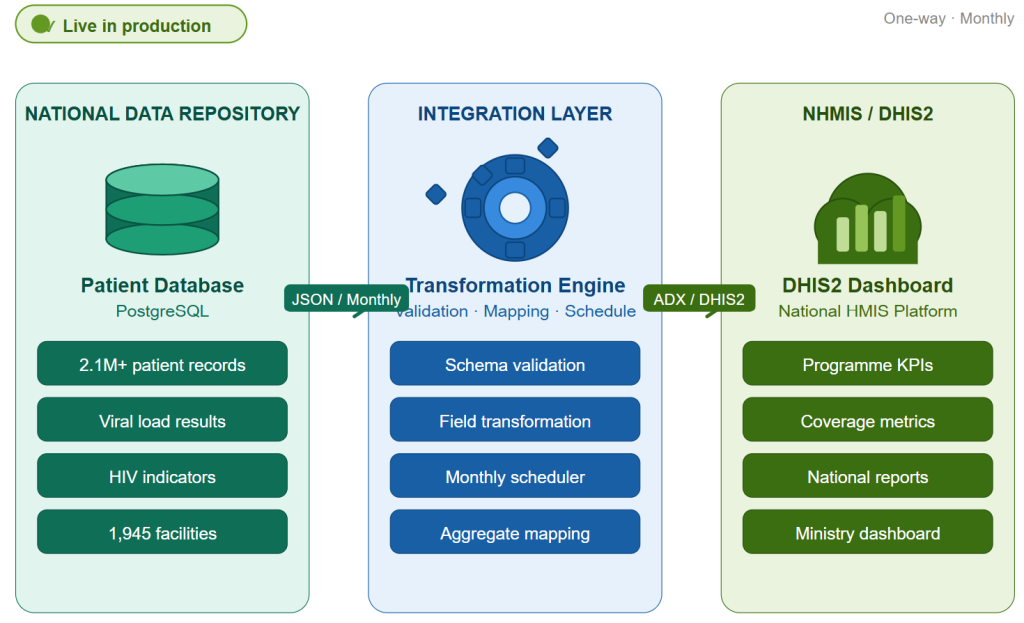
Project 1: NDR to NHMIS: Completed and Live in Production. Bringing the National Program Data Current
APIN/PHIS3 Project implemented the initial integration that achieved this goal, connecting the Nigeria National Data Repository (NDR) to the National Health Management Information System (NHMIS), which is based on the DHIS2. It is connected and operational in the National production environment and is performing as intended.
The NDR contains over 1.7 million individual patient records that contain clinical and treatment histories, viral loads, and linkage to care across 2,111 reporting sites as of 27th July 2027. The NHMIS is the system that tracks the performance of Nigeria’s National HIV program and is used by health ministry officials, program managers, and international partners to assess the performance of the country’s HIV response.
Previously, to get NDR data into NHMIS, someone had to manually extract and reformat it, a time-consuming, imprecise process that caused significant delays in reporting national statistics. The new integration has eliminated this lag. Now, each month, relevant aggregate HIV indicators are automatically transmitted to NHMIS from the NDR via a structured and validated data transfer. The national dashboard remains up to date and current without requiring anyone to manually transfer the data.
Achievements
- APIN/PHIS3 deployed the system, and it is running in the national production environment for reporting and decision-making.
- Monthly automated data push that does not require manual extraction or submission required
- Aggregate HIV indicators flowing live to national programme dashboards for treatment data
- Data validated and transformed before every transfer on the schedule moments.
Project 2: EMR to NDR via OpenHIM Tested and Scaling. Automating the clinical data pipeline
APIN/PHIS3 Project implemented the second integration that addresses the foundational question underneath the entire NDR enterprise: how does patient-level clinical data get from the facility where care is delivered into the national repository that tracks it? For years, the answer was a semi-manual process where EMR systems generating XML files that staff would upload, with variable completeness and timing, and no visibility into what made it through and what didn’t.
The EMR–NDR integration, built using OpenHIM as the orchestration middleware, replaces that process with a fully automated pipeline. When a clinical encounter is recorded in a facility-level EMR, the data travels through OpenHIM, which validates the record, routes it correctly, handles errors and retries, and delivers it to the NDR without any human intervention required. The exchange runs one way: from the facility EMR to the national repository.
This integration has been tested and confirmed operational. What’s underway now is the harder, methodical work of scaling it: expanding coverage across all facilities in the programme, validating data quality at each site, and establishing it as the standard pathway through which clinical data reaches the NDR.
System Architecture
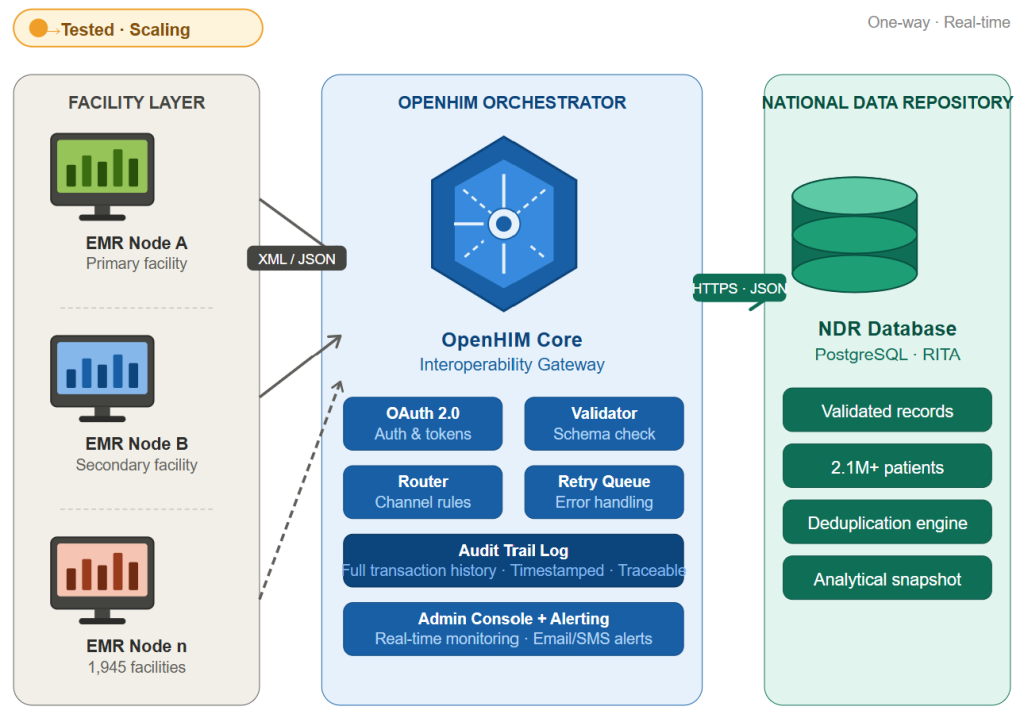
Status: Tested and operational, scaling across programme.
OpenHIM’s role deserves attention. It is not just a data pipeline, but it is an intelligent intermediary. It catches malformed records before they corrupt the NDR, queues messages when systems are temporarily unavailable, logs every transaction for audit, and provides administrators with a real-time view of what is flowing and what is not. When something goes wrong, the problem is visible and traceable immediately.
Achievements
- APIN/PHIS3 Project has successfully executed OpenHIM orchestrator deployed and validated
- End-to-end data flow tested and confirmed operational.
- APIN/PHIS is currently scaling across all programme areas that will then be deployed across facilities.
- Facility-by-facility onboarding and data quality validation underway.
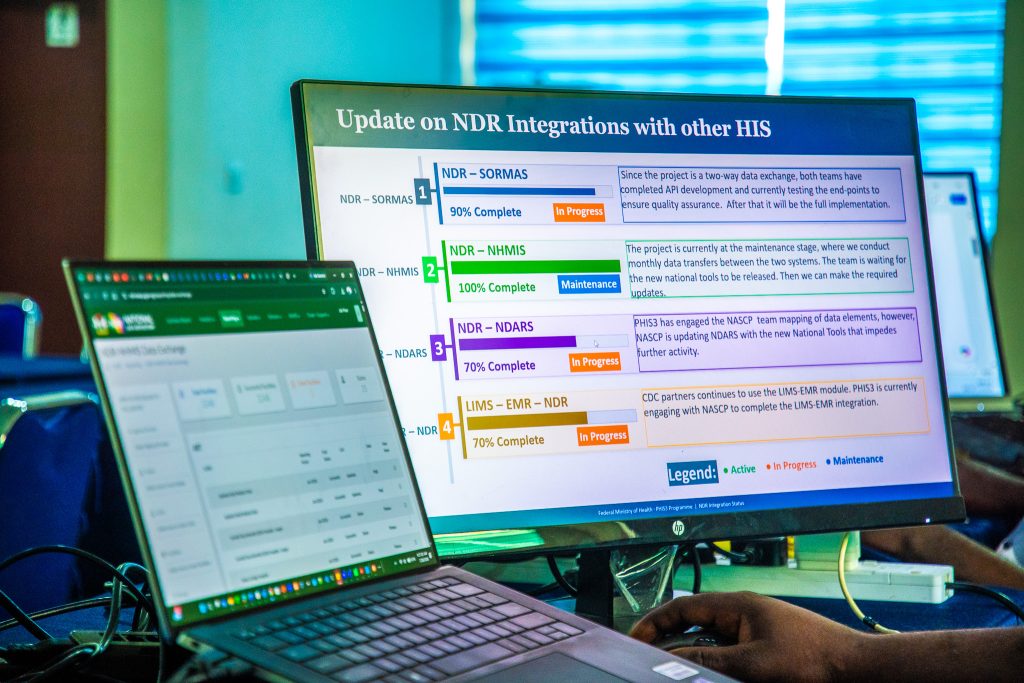
Project 3: NDR and SORMAS are 95% complete. Closing the loop with two-way exchange.
APIN/PHIS3 Project commenced the implementation of the third project that is the most technically ambitious, and it is nearly done. At 95% completion, the two-way interoperability between the NDR and SORMAS known as the Surveillance, Outbreak Response Management and Analysis System that is in its final pre-production validation before moving to the live environment.
This integration is different from the first two in one critical way: data flows in both directions. SORMAS captures disease outbreak data in real time HIV and MPOX surveillance indicators including case notifications, CD4 counts, viral load results, samples collected, confirmed cases, and contact tracing records. The NDR holds the longitudinal patient record: HIV surveillance history, recency of infection classifications, case-based surveillance detail, and mortality data that gives outbreak records their clinical context.
Without this connection, a SORMAS officer responding to an MPOX cluster has no way to know the inside their system and whether a given case has a prior HIV diagnosis, what their most recent viral load was, or whether they are currently linked to care. That information exists in the NDR, but it might as well be in a different building. The two-way integration changes that completely.
“For the first time, a surveillance officer will see both the outbreak event and the patient’s clinical history in one operational picture, in real time, without switching systems.”
System Architecture
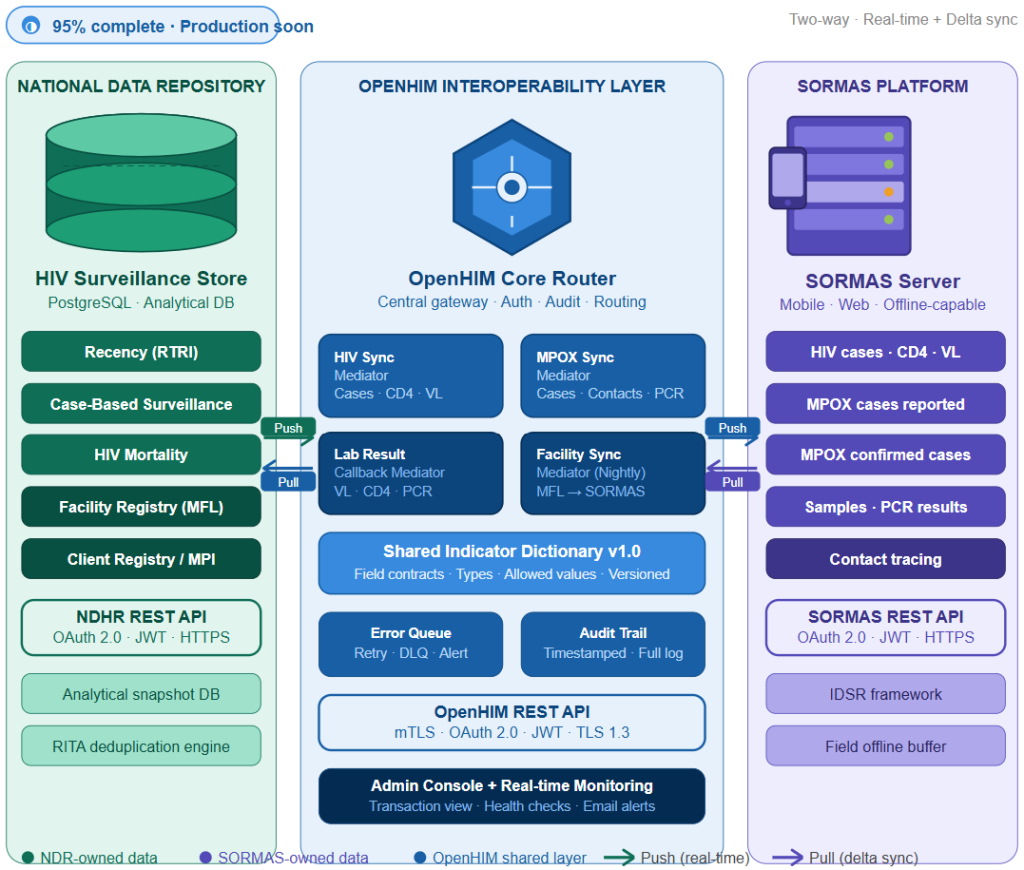
Achievements
- APIN/PHIS3 had integrated the two systems with the focus of key HIV and MPOX indicator APIs built and internally Postman-tested by both teams.
- OpenHIM mediators configured for all indicator domains
- Bidirectional data validated in sandbox environment
- APIN/PHIS3 in conjunction with the NCDC staff will perform the final pre-production validation underway for production deployment imminent
The Road Ahead through Five Phased Journey
Each project was designed with the next one in mind. The NDR–NHMIS integration established that automated data flows to national platforms are achievable and sustainable. The EMR–NDR integration proved that OpenHIM can orchestrate that flow reliably at facility level across a complex network. The NDR–SORMAS integration applies that infrastructure to a bidirectional, real-time surveillance challenge that was previously too complex to tackle programmatically.
NDR → NHMIS (DHIS2) currently in live production
Monthly automated aggregate data exchange. National HIV indicators on the programme dashboard without manual intervention.
EMR → NDR via OpenHIM: Tested, Scaling
Automated clinical data pipeline from facility EMRs to the national repository. Operational and expanding across the full programme.
NDR ↔ SORMAS: 95% complete, production imminent
Two-way HIV and MPOX surveillance exchange through OpenHIM. Final validation underway. Moving to production shortly.
Master Patient Index and FHIR R4 migration: Planned
Biometric patient identity resolution across all systems. FHIR R4 payloads for international interoperability compliance. FHIR Implementation Guide (IG) development underway for the upgraded system.
SORMAS → national HMIS direct link: Planned
Outbreak case data feeding Nigeria’s DHIS2 national dashboard directly, alongside NDR aggregate exports.
NHDD → National Health Data Dictionary: Ongoing.
Currently, there are no standardized national data dictionaries that will be a gold standard for the development of any health systems conforming with the international terminology services for quality data for decision making. The implementation of this project will serve as a single source of through for the full implementation of the National Digital Health Architecture (NDHA).
Three Projects: One Direction. A changed Infrastructure
Nigeria’s health interoperability programme is not a single project with a single launch date. It is a sequenced, layered effort that is one that has delivered real results in production, has a second pipeline operational and scaling, and is days away from completing its most sophisticated integration yet.
When the full programme is complete, a clinician entering a record at any facility in Nigeria will be contributing to a national health intelligence system that knows what it knows, shares it automatically, and does so in time to matter. A surveillance officer in the field will have the full clinical picture of every case they manage, without leaving their system, without making a phone call, and without waiting for a weekly report.